Genus: Prognathodon DOLLO, 1889
Etymology:
= Dollosaurus IAKOVLEV, 1901
Etymology:
= Prognathosaurus DOLLO, 1889b
Note: DOLLO named Prognathosaurus to replace Prognathodon because
he thought
it was preoccupied by Prognathodus Edgerton, which is not the case.
Etymology:
= Tenerasaurus KADDUMI, 2009
Etymology: Latin, tenera, "young" and Greek, sauros, "lizard."
Note: DOLLO named Prognathosaurus to replace Prognathodon because he thought it was preoccupied by Prognathodus Edgerton, which is not the case.
Species: platyodon (SAUVAGE, 1873) emend BUFFETAUT & BARDET, 2010, 2012 (nomen dubium)
Note: the authors place this species into Prognathodon sp, since the species name is valid it is hear placed in the genus Prognathodon as a nomen dubium)
Etymology:
= Mosasaurus platyodon SAUVAGE, 1873 (nomen dubium)
Holotype: FSL 532948
Locality: La Bonneville, Normandy, France.
Horizon:
Biostratigraphy: Baculites Limestone.
Age: Maastrichtian Stage, Uppermost Senonian Subepoch, Uppermost Gulf Epoch, Late Cretaceous.
Material: A tooth crown from teh median part of the jaw.
____________________________________________________________________________________
Species: solvayi DOLLO, 1889
Etymology:
= Prognathosaurus solvayi (DOLLO,
1889) DOLLO, 1889
Holotype: IRSNB R33
Locality: Mesvin, Solvay quarry, Belgium.
Horizon: Ciply Phosphatic Chalk.
Biostratigraphy:
Age: Maastrichtian Stage, uppermost Senonian subepoch, Gulf Epoch, Late Cretaceous.
Material: Nearly complete skull and Incomplete skeleton comprising thoracic dorsal and caudal vertebrae, ribs, right and left fragments of scapula and coracoid.

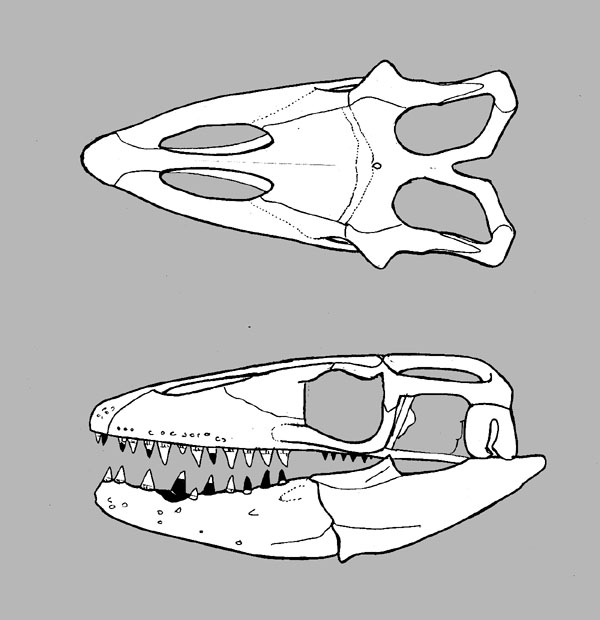
Prognathodon solvayi IRSNB R33 after LINGHAM-SOLIAR & NOLF, 1989: A) dorsal and B) lateral views.
Referred material:
IRSNB R107: Fragments of skull and dentaries.
Locality: Spiennes, Houzeau Quarry, Belgium.Horizon: Ciply Phosphatic Chalk.
Biostratigraphy:
Age: Maastrichtian Stage, uppermost Senonian subepoch, Gulf Epoch, Late Cretaceous.
Material:
IRSNB R108: Jaw and skull fragments, some ribs, vertebrae.
BARDET, CORRAL & PEREDA SUBERBIOLA, 1999
Locality: Disused sand quarry near the village of Lano, Lano quarry, Trevino County, about 20 km SE of the City of Vitoria, Basque-Cantabric Basin, Basque Province, Iberian Peninsula, Spain.
Horizon: Sobrepena Formation.
Biostratigraphy:
Age: Uppermost Campanian-Lowermost Maastrichtian Stage, Upper Senonian subepoch, Upper Upper Gulf Epoch, Late Cretaceous.
Material:
MCNA 6449: Tooth.
BARDET, MARTIN, CORRAL, PEREDA SUBERBIOLA, & ASTIBIA, 2013
LU-GMS/LAN001: A marginal tooth probably from the median part of the jaws.
LU-GMS/LAN005: A marginal tooth form teh median part of the jaws.
= Prognathodon cf. solvayi REMPERT, MARTENS & MELCHERS, 2024b
Locality: Holden Beach, Brunswick County, North Carolina.
Horizon: Peedee Formation.
Biostratigraphy:
Age: Upper Maastrichtian Stage, Late Senonian Subepoch, Late Gulf Epoch, Latest Cretaceous.
Material:
VANPS 13.0181: Marginal tooth crown.
_____________________________________________________________________________________
Species: compressidens (GAUDRY, 1892)
SCHULP, POLCYN, MATEUS, JACOBS & MORALS,
2008
=
Liodon compressidens GAUDRY, 1892
Etymology:
Holotype: MNHN AC 1875-575
Locality: Michery, Bourgogne Region, Yonne Department, France.
Horizon:
Biostratigraphy: Belemnitella quadrata zone.
Age: Early Campanian, Upper Senonian Subepoch, Upper Gulf Epoch, Late Cretaceous.
Material: Fragmentary skull.
Referred material:
BARDET, 2012
Locality: Mortagne-sur-Gironde, Poitou-Charentes region, France.
Horizon:
Biostratigraphy:
Age: Early Campanian, Upper Senonian Subepoch, Upper Gulf Epoch, Late Cretaceous.
Material:
MNHN 1886-5: Poorly preseved jaw fragment with teeth.
_____________________________________________________________________________________
Species: mosasauroides (GAUDEY, 1892) SCHULP, POLCYN, MATEUS, JACOBS & MORALS,
2008
= Leiodon mosasauroides GAUDEY, 1892
Etymology:
Holotype: MNHN 1891-14
Locality: In the region of Cardesse near Oloron, Pyrenean Basin (Basses-Pyrenees), Pyrenees Atlantique Department, Southwest France.
Horizon:
Biostratigraphy:
Age: Upper Senonien Subepoch, or possibly Maastrichtian Stage, Gulf Epoch, Late Cretaceous.
Material: Fragmentary skull.
Referred material:
POMPECKJI, 1910, LINGHAM-SOLIAR, 1993, SACHS, 2000
= Mosasaurus cf. mosasauroides POMPECKJI, 1910
= Leiodon cf. L. mosasauroides SACHS, 2000Locality: Halden, Westfalen, North Rhine-Westphalia State, Germany.
Horizon:
Biostratigraphy:
Age: Upper Senonian Subepoch, Upper Gulf Epoch, Late Cretaceous.
Material:
GPIG 106-1: Fragmentary maxilla, paddle-elements, rib-fragments and vertebrae.
_____________________________________________________________________________________
Species: lutugini (IAKOVLEV, 1901)
LINGHAM-SOLIAR, & NOLF, 1989
Etymology:
= Dollosaurus lutugini IAKOVLEV, 1901
Holotype:
Locality: Donets River, Donetz Basin, Voroshilovgrad Region, Ukraine.
Horizon:
Biostratigraphy: Belemnitella mucronata Zone.
Age: Upper Campanian Stage, Senonian subepoch, Upper Gulf Epoch, Late Cretaceous.
Material: Partial skull and skeleton.
_____________________________________________________________________________________
Species: giganteus DOLLO, 1904
Etymology:
= Mosasaurus giganteus (DOLLO, 1904)
= Prognathosaurus giganteus (DOLLO,
1904)
Holotype: IRSNB R106
Locality: Spiennes, Solvay Quarry, Belgium.
Horizon: Ciply Phosphatic Chalk.
Biostratigraphy:
Age: Maastrichtian Stage, uppermost Senonian subepoch, Gulf Epoch, Late Cretaceous.
Material: Incompletely preserved skull and remains of postcranial material.

Prognathodon giganteus after LINGHAM-SOLIAR & NOLF 1989: A) dorsal and B) lateral views.
Referred material:
BARDET, CAPPETTA, PEREDA SUBERBIOLA, MOUTY, AL MALEH, AHMAD, KHRATA & GANNOUM, 2000
Locality: Bardeh mine, Palmyra area, Palmyrides China of Syria.
Horizon: Phosphatic deposit.
Biostratigraphy:
Age: Maastrichtian Stage, uppermost Senonian subepoch, Gulf Epoch, Late Cretaceous.
Material:
Number: Not given: Teeth.
BARDET, 2012
MNHN-KHN7: Tooth.
Locality: Khneifiss mine, Palmyra area, Palmyrides China of Syria.
Horizon: Phosphatic deposit.
Biostratigraphy:
Age: Maastrichtian Stage, uppermost Senonian subepoch, Gulf Epoch, Late Cretaceous.
Material:
Number: Not given: Teeth.
BARDET & PEREDA SUBERBIOLA, 2002
Locality: Ruseifa Quarry, near Amman, Jordan.
Horizon: Phosphatic.
Biostratigraphy:
Age: Late Cretaceous.
Material:
Uncatalogued: Teeth.
DOLLO
Locality: Near Zichen, Limburg Province, The Netherlands.
Horizon:
Biostratigraphy:
Age: Lower – Upper Maastrichtian Stage, uppermost Senonian subepoch, Gulf Epoch, Late Cretaceous.
Material:
Number: Not given: Teeth.
cf. giganteus LINGHAM-SOLIAR, 1994
Locality: Manzadi, Bas Congo, Democratic Republic of the Congo (Formerly the Belgian Congo, Zaire).
Horizon:
Biostratigraphy:
Age: Maastrichtian Stage, uppermost Senonian subepoch, Gulf Epoch, Late Cretaceous.
Material:
Number: Not given: 2 teeth, one with the top of the crown absent.
_____________________________________________________________________________________
Species: capensis (BROOM, 1912) emend WOOLEY, CHINSAMY & CALDWELL, 2022
= Tylosaurus capensis BROOM, 1912
= Taniwhansaurus capensis (BROOM, 1912) emend JIMENEZ-HUIDOBRO & CALDWELL, 2019
Note: Taniwhansaurus indet 2 (Tylosaurus capiensis) JIMENEZ-HUIDOBRO & CALDWELL, 2019
Etymology:
Holotype: SAM-PK5625
Locality: Southwest of the Mzamba River, Transkei (Pondoland), Eastern Cape Province, South Africa.
Horizon: Chalk.
Biostratigraphy:
Age: Late Cretaceous.
Material: Almost complete frontal, anterior portion of parietals and portions
of postorbitofrontals.
_____________________________________________________________________________________
Species: (?) donicus (PRAVOSLAVLEV,
1914) RUSSELL, 1967
= Mosasaurus donicus PRAVOSLAVLEV, 1914
Etymology:
Holotype:
Locality: Liska River Basin, Don Region, European Russia.
Horizon:
Biostratigraphy:
Age: Campanian Stage, Senonian subepoch, Upper Gulf Epoch, Late Cretaceous.
Material: Fragmentary remains.
_____________________________________________________________________________________
Species: saturator DORTANGS, SCHULP,
MULDER, JAGT, PEETERS & GRAAF, 2002
Etymology: Latin, saturator, "he who gives satisfacation"; both
to Maastrichtian sharks as well as recent palaeontologists).
Holotype: NHM 1998141
Locality: ENCI-Maastricht B.V. quarry, 54°49’N, 5°41’E, 3 km S of Maastricht, Limburg Province, The Netherlands.
Horizon: Lanaye Member, Gulpen Formation.
Biostratigraphy: Belemnitella junior Cephalopod zone.
Age: Maastrichtian Age, Upper Senonian Subepoch, Upper Gulf Epoch, Late Cretaceous.
Material: Near-complete skull, articulated cervical and anterior dorsal vertebrae
with cervical and dorsal ribs, isolated pygal and caudal vertebrae, scapula-coracoid
and scattered elements of appendicular skeleton.
Note: Some ribs have bite marks from sharks (ROTHSCHILDS, MARTIN & SCHULP,
2005)
Referred material:
= Prognathodon cf. saturator SCHULP & JAGT, 2015
Locality: Northerastern corner of the ENCI-Heidelberg Cement Group Quarry, Limburg Province, south of Maastricht, the Netherlands.
Horizon: Lanaye Member, Gulpen Formation.
Biostratigraphy:
Age: Upper Maastrichtian Stage, uppermost Senonian subepoch, Gulf Epoch, Late Cretaceous.
Material:
NHMM JJ 15128: Fragmentary left quadrate.
= Prognathodon cf. saturator MATEUS, POLCYN, JACOBS, ARAUJO, SCHULP, MARINHEIRO, PEREIRA & VINEYARD, 2011
Locality: "Bentiaba 2" locality, Namibe Province, Angolia.
Horizon:
Biostratigraphy:
Age: Middle Maastrichtian Stage, Late Senonian Stage, Late Gulf Epoch, Late Cretaceous.
Material:
MGUAN-PA169: Fragmentary dentary including tooth crown.
_____________________________________________________________________________________
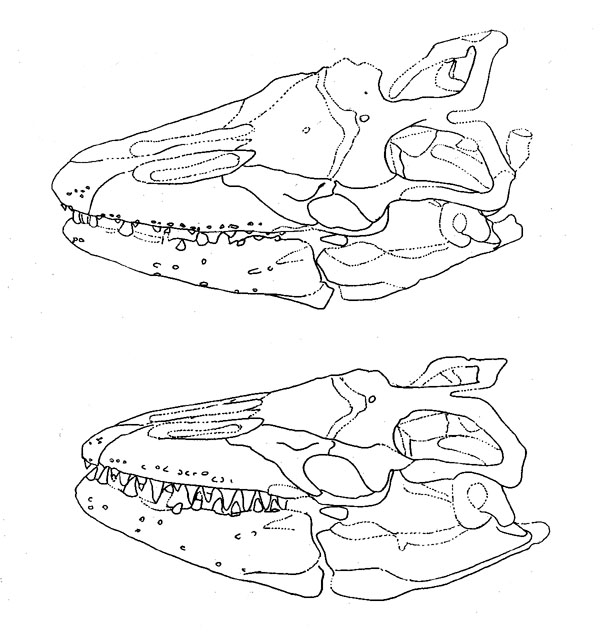
Species: currii CHRISTIANSEN & BONDE, 2002
Etymology: In honor of Philip J. Currie, Royal Tyrell Museum of Paleontology,
Drumheller, Alberta, Canada, for his fiftieth birthday (March, 1999)
Holotype: HUJ.OR 100
Locality: Phosphate mining in the Oron Mine, Negev Desert, southern Isreal.
Horizon:
Biostratigraphy:
Age: Campanian Stage, Senonian Subepoch, Upper Gulf Epoch, Late Cretaceous.
Material: Skull and 8 anterior cervical vertebrae.
Referred material:
BARDET, SUBERBIOLA, IAROCHENE, AMALIK & BOUYA, 2005
Locality: Ben Guerir area, Ganntour Basin, Morocco.
Horizon: Phosphatic deposits.
Biostratigraphy:
Age: Maastrichtian Stage, uppermost Senonian subepoch, Gulf Epoch, Late Cretaceous.
Material:
OCP.DEK/GE 349, 350: 2 median teeth.
Note: From LEvel C5.
OCP.DEK/GE uncatalogued: 5 teeth from different levels.
Note: 1 from level C6, 1 from level C4, 2 from level C3, and 1 from level C2.
_____________________________________________________________________________________
Species: kianda SCHULP, POLCYN, MATEUS, JACOBS & MORAIS, 2008
Etymology: Named after Kianda (named used in apposition), an Angolan
mythological deity who rules the ocean and its fish. In one tale, Kianda ppears
in a form of a skull.
= Prognathodon Nova SCHULP, MATEUS, POLCYN & JACOBS, 2006
= Prognathodon sp SCHULP, POLCYN, MATEUS, JACOBS, MORAIS & da SILVA TAVARES, 2006
Holotype: MGUAN PA 129 (old ML/MGUANO07)
Locality: Near the village of Bentiaba (Formerly Sao Nicolau), Namibe Province (Formerly Mocamedes), souhwestern Angola.
Horizon:
Biostratigraphy:
Age: Middle Maastrichtian Stage, uppermost Senonian subepoch, Gulf Epoch, Late Cretaceous.
Material: Fragmentary skull.
Paratypes:
MGUAN PA 128 (old ML/MGUANO05), 149, 150, 151: Fragmentary skulls?
Referred material:
POLCYN, SCHULP & GONCALVES, 2023
Locality: Bentaba, Angolia.
Horizon: 1 meter above "Bench 19" of Straganac et al, (2015)
Biostratigraphy:
Age: Middle Maastrichtian Stage, uppermost Senonian subepoch, Gulf Epoch, Late Cretaceous.
Material:
MGUAN PA 183: Skull and fragmentary skeleton.
Note: With stomach contents of Prognathodon kinada (MGUAN PA183C), Gavialimimus sp (MGUAN PA183b) and Bentiabasaurus jacobsi (MGUAN P183D).
MGUAN PA183C: Fragmentary premaxill and maxillae.
_____________________________________________________________________________________
Species: hudae KADDUMI, 2009
Etymology: In honor of the author's daughter "Huda" who never failed to recognize every new fossil he discovered.
Holotpe: ERMNH HFV 277
Locality: Harrana, Jordan.
Horizon: Muqaqqar Chalk Marl Formation.
Biostratigraphy:
Age: Maastrichtian Stage, uppermost Senonian subepoch, Gulf Epoch, Late Cretaceous.
Material: Almost complete left dentary with four teeth preserved (2, 4, 8, 10) and an incomplete right dentary with three teeth (2, 3, 8).
_____________________________________________________________________________________
Species: hashimi (KADDUMI, 2009) LINDGREN, KADDUMI, & POLCYN,
2013
= Tenerasaurus hashimi KADDUMI, 2009
Etymology:
Holotype: ERMNH HFV 197
Locality: Konservat-Lagerstatte of Harrana, Central Jordan.
Horizon:
Age: Latest Maastrichtian Stage, uppermost Senonian subepoch, Gulf Epoch, Late Cretaceous.
Material: Nearly complete skeleton, missing the skull and tip of tail.
Note: Has skin impressions on the flippers, and bukibed tail.
_____________________________________________________________________________________
Species: cipactli RIVERA-SYLVA, SANCHEZ-URIBE, GUZMAN-BUITERREZ, RODRIGUE, RANGEL-MORELOS & LONGRICH, 2026
Etymology: The specific epithet cipactli refers to teh primordial aquatic monser of Mexican mythology, described as a hybrid reptilian and half fish creature, whos dismembered body gave rise to to the world in pre-Columbian cosmogony (Codex Fejervary-Mayer: 42; Codex Vaticanus B:26).
Holotype: UANL-FCT-R4
Locality: Rancho Las Barretas, 10km northest of Linares, Nueveo Leon State, Mexico.
Horizon: Mendez Formation.
Biostratigraphy:
Age: Early Maastrichtian Stage, uppermost Senonian subepoch, Gulf Epoch, Late Cretaceous.
Material: Part of the cranial vault including the frontal, anterior part of the parietal, medial portions of the prefrontals, both postorbitofrontals, and portions of the internarial bar up to the level of the posterior end of the nares, both maxillae are preserved in articulation with the rostral extremity of the premaxilla, fragments of the jugal and pterygoid, ventral half of the right quadrate and two-thirds of the mandibles.